TEA: Tiny Algorithm, Big Heart
This is an implementation of part of the Tiny Encryption Algorithm that I wrote in Python for a computer and network security class. The assignment had a narrow set of requirements: perform one pair of encryption rounds, show the intermediate values, and reverse them. I added input handling, tests, continuous integration, and a little extra functionality, then refactored it.
This is teaching code. It performs two rounds so the arithmetic can be inspected; it is not a complete implementation of TEA and should not be used to encrypt anything important.
Enough notation to follow it
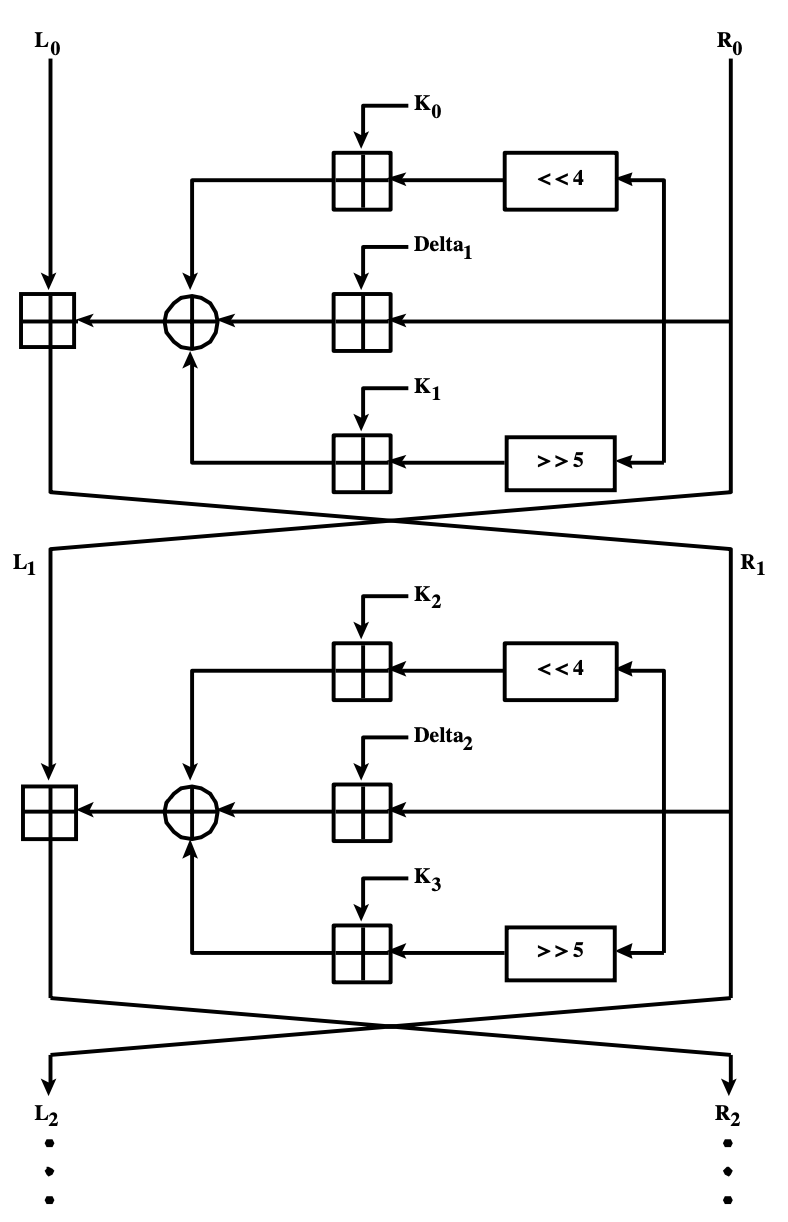
TEA works on a 64-bit block split into two 32-bit halves, shown in the diagram as and . Its 128-bit key is split into four 32-bit words, through . One round leaves one half in place and uses it to change the other. The next round does the same thing from the other side.

There are only three operations to keep track of:
<<and>>shift a 32-bit value left or right.^is XOR. A bit in the result is 1 when the two input bits differ.- Addition modulo is ordinary addition with anything beyond 32 bits discarded.
Hexadecimal is just a compact way to write the same bits. Four binary digits fit into one hexadecimal digit, so 10011111111101010111100111100101 becomes 0x9FF579E5. The 0x prefix says that the number is hexadecimal.
Python integers do not naturally wrap at 32 bits, so the implementation uses c_uint32 from ctypes. That makes additions and subtractions behave like unsigned 32-bit arithmetic.
Walking through two rounds
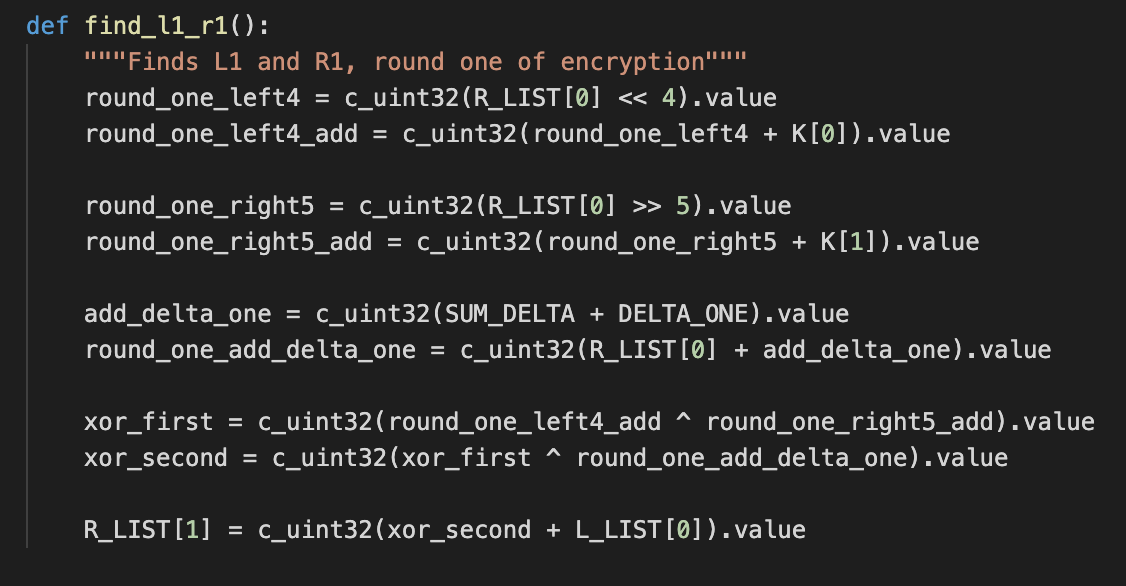
The first round copies into . It also sends down three branches: shift left by 4 and add ; shift right by 5 and add ; add the first delta value. XOR those three results, add , and the result is .
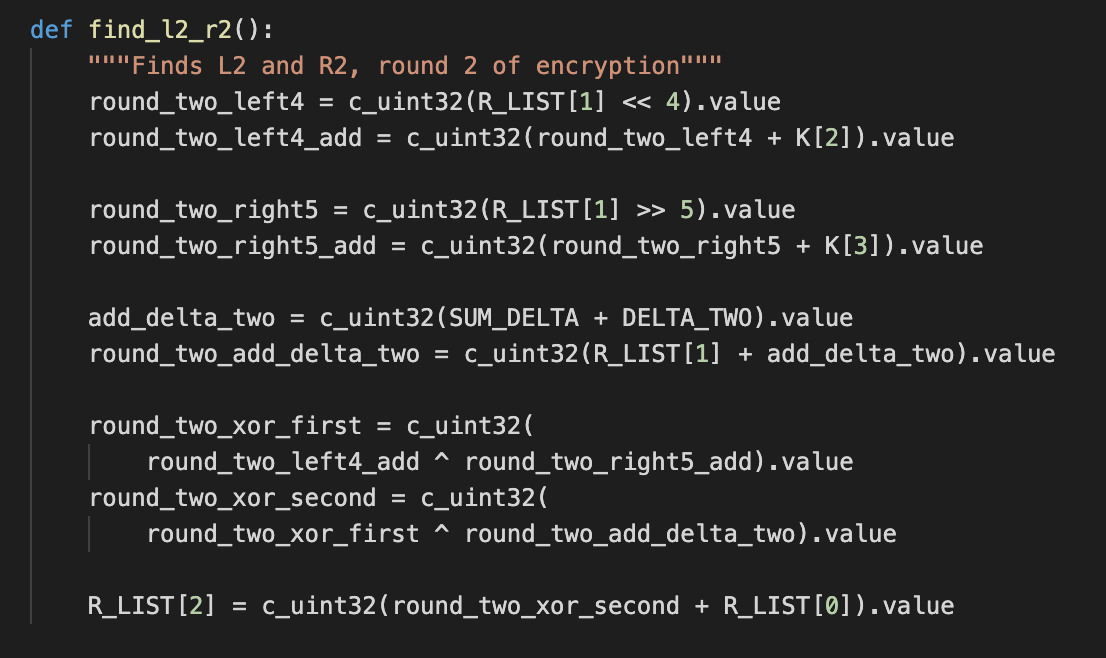
The second round starts from and . It repeats the same structure with , , and the second delta value, producing and .
At that point the assignment calls the two 32-bit values ciphertext. Decryption does the same work in reverse. It reconstructs the three branches from the known half, XORs them, and subtracts instead of adding. Running both reverse steps recovers and exactly.
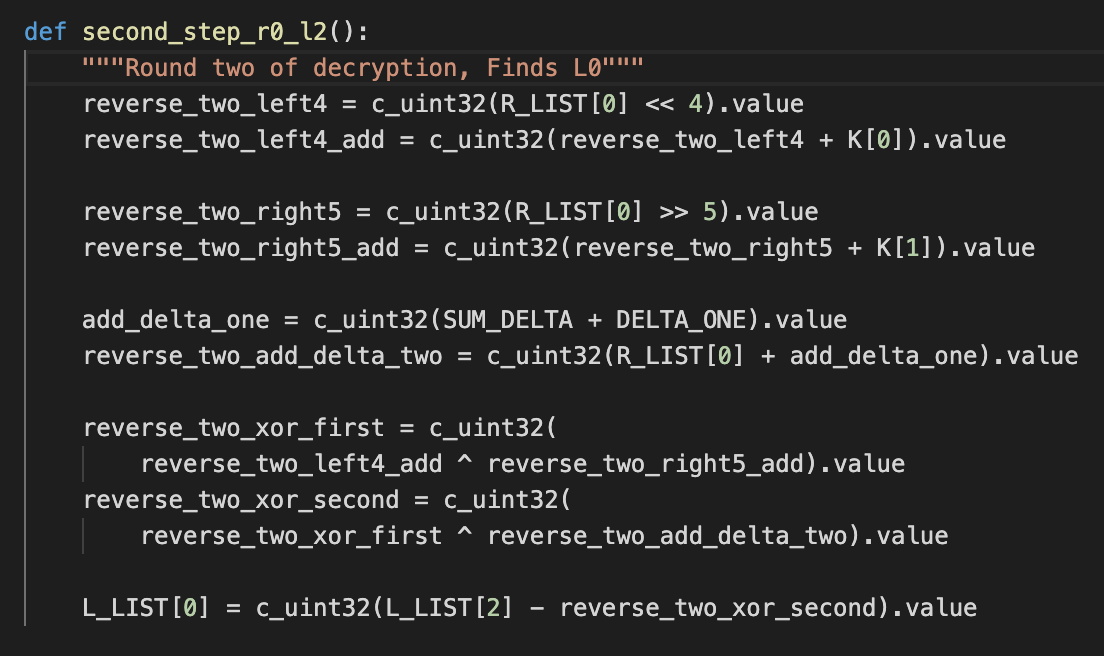
The code is verbose on purpose. Each branch has its own named intermediate value because I was trying to grok the algorithm: to understand it closely enough that the notation stopped hiding the mechanism.
What the exercise proves
The tests run known inputs through encryption and decryption and check every intermediate value. At the time, the test report showed 96 percent coverage. Travis also ran Pylint, Flake8, coverage, Codecov, and SonarCloud on the repository.
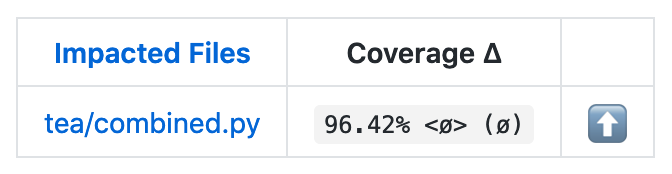
That proves the program implements the assignment consistently. It does not prove that the cipher is secure.
Full TEA normally runs 32 cycles, or 64 rounds, with a fixed delta derived from the golden ratio. This assignment used only one cycle and supplied its own two delta values so the calculation could be checked by hand. TEA also has known related-key and equivalent-key weaknesses; the equivalent keys reduce its effective key size from 128 to 126 bits. It is an unusually clear cipher to learn from, but there is no reason to choose it for a new system.
The value of the exercise was seeing that directly. Encryption and decryption were not black boxes anymore. They were a small sequence of shifts, XORs, and wrapping additions that could be followed in both directions, line by line.